

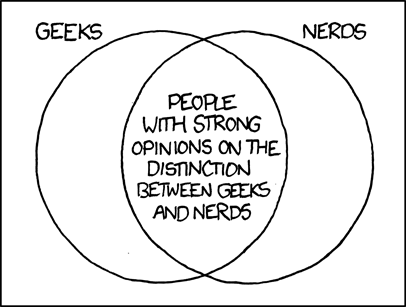

Sources: http://www.xkcd.com/668/
I love showing this engaging example to my students to emphasize the importance of the various curve-sketching techniques that are taught in Precalculus and Calculus.
Problem. Sketch the graph of 
“Solution”. Let’s plug in some convenient points, graph the points, and then connect the dots to produce the graph.





That’s five points (shown in red), and surely that’s good enough for drawing the picture. Therefore, we can obtain the graph by connecting the dots (shown in blue). So we conclude the graph is as follows.


Of course, the above picture is not the graph of

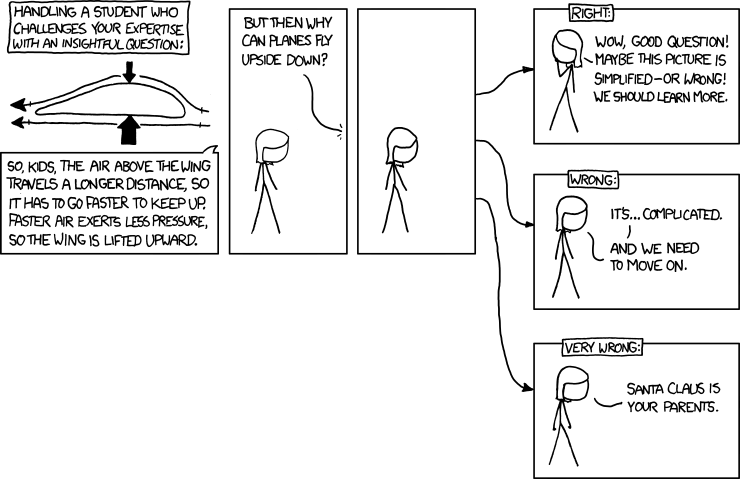
Source: http://www.xkcd.com/803/
Sage words of wisdom that I gave one day in my statistics class:
If the alternative hypothesis has the form
, then the rejection region lies to the right of
. On the other hand, if the alternative hypothesis has the form
, then the rejection region lies to the left of
On the other hand, if the alternative hypothesis has the form
, then the rejection region has two parts: one part to the left of
Here’s a standard problem that could be found in any Algebra I textbook.
Find the equation of the line between
and
.
The first step is clear: the slope of the line is
At this point, there are two reasonable approaches for finding the equation of the line.
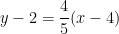
Method #1. This is the method that was hammered into my head when I took Algebra I. We use the point-slope form of the line:
For what it’s worth, the point-slope form of the line relies on the fact that the slope between 


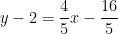
Method #2. I can honestly say that I never saw this second method until I became a college professor and I saw it on my students’ homework. In fact, I was so taken aback that I almost marked the solution incorrect until I took a minute to think through the logic of my students’ solution. Let’s set up the slope-intercept form of a line:
Then we plug in one of the points for 


Therefore, the line is 
My experience is that most college students prefer Method #2, and I can’t say that I blame them. The slope-intercept form of a line is far easier to use than the point-slope form, and it’s one less formula to memorize.
Still, I’d like to point out that there are instances in courses above Algebra I that the point-slope form is really helpful, and so the point-slope form should continue to be taught in Algebra I so that students are prepared for these applications later in life.
Topic #1. In calculus, if 


This linearization is immediately obtained from the point-slope form of a line. It also can be obtained using Method #2 above, so it takes a little bit of extra work.
This linearization is used to derive Newton’s method for approximating the roots of functions, and it is a precursor to Taylor series.
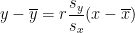
Topic #2. In statistics, a common topic is finding the least-squares fit to a set of points 
In this equation,
 and
and  are the means of the
  and
and  values, respectively.
 and
and  are the sample standard deviations of the and values, respectively.
 is the correlation coefficient between the and values.
The formula of the regression line is decidedly easier to write in point-slope form than in slope-intercept form. Also, the point-slope form makes the interpretation of the regression line clear: it must pass through the point of averages 
In my capstone class for future secondary math teachers, I ask my students to come up with ideas for engaging their students with different topics in the secondary mathematics curriculum. In other words, the point of the assignment was not to devise a full-blown lesson plan on this topic. Instead, I asked my students to think about three different ways of getting their students interested in the topic in the first place.
I plan to share some of the best of these ideas on this blog (after asking my students’ permission, of course).
This student submission comes from my former student Dale Montgomery. His topic, from Geometry: the area of a circle.
History
Archimedes was the mathematician who we attribute with finding the area of a circle to be Where r is the radius and π is the ratio of circumference to diameter of a circle. (Note that Archimedes was not the first to find the area of a circle, but was the first to find π). I would really like to start the class with something along the lines of introducing Archimedes supposed final words “Do not disturb my circles.” And then go into the death of Archimedes and the mystery surrounding his tomb, such as the account of Cicero and the fact that no one knows where the tomb is now. Cicero said that his tomb had a sphere inscribed in a cylinder, which Archimedes considered to be his greatest mathematical proof. From there, the class should have great interest in what is going on. And we can talk about the fact that the area of a circle is the same as the area a triangle with the same base as the circumference and the same height as the radius. 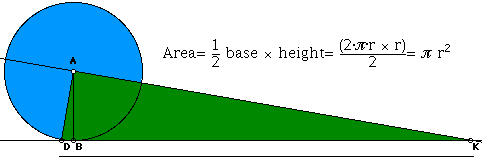
Rorres, Chris. “Tomb of Archimedes – Illustrations”. Courant Institute of Mathematical Sciences. Retrieved 2011-03-15.
Culture
http://newsfeed.time.com/2013/02/02/are-crop-circles-more-than-just-modern-pranks/
I would show this article in class, most likely passing it out to read. I would ask if they thought it was a prank, and then give them a similar picture as presented in the article but mapped out with radiuses. Then I would say that the average person could do so many square feet of crop’s per hour. If it gets dark at 9 pm and the sun comes up at 6 am, could a person pull a prank like this?
After we discussed how to find the area of a circle I would have found one that it was impossible for one person to do. Then I would display this youtube video.
Seeing that there were 2 people working on it could display that it is possible for it to be a hoax. I like this because it gives the students a way to analyze information that they are given. Does it make sense for these things to be aliens? Not really, so let’s find other explanations. It both introduces the concept and teaches some critical thinking skills.
Applications
You could apply the area of a circle to the diameter of a pizza. When you order pizza you order things like an 8 or a 12 inch. These are diameters and do not give the best idea of how much pizza you are actually getting. You can even include this lesson with a pizza party or something similar. This would easily get kids excited since it is something that most kids like, and they would have the possibility of getting pizza afterwards.

I’m constantly amazed at the number of college students who, through no fault of their own, simply were never taught this simple trick for multiplying by 9 when they were kids.
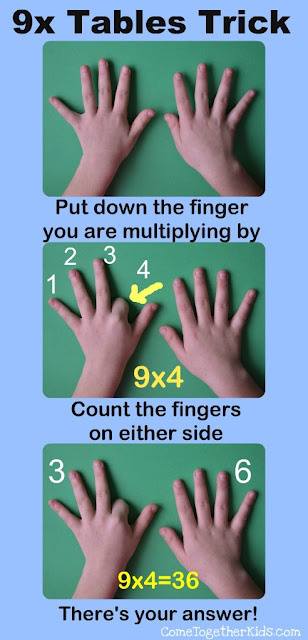 Why does this trick work? In the picture, if the left pinkie is brought down, there are nine fingers to the right that are up (corresponding to


I just read a couple of nice tricks for checking if a number is divisible by 7. There are standard divisibility tests for 2, 3, 4, 5, 6, 8, 9, 10, 11, and 12, but checking a number is divisible by 7 is somewhat more difficult. But these two tricks make the task more manageable. The proofs for these tricks can be found in the given links.
Method #1, from http://www.arscalcula.com/mental_math_divisibility_tests.shtml: Add multiples of 7 to get a multiple of 10, and then lop off the 0.
Here’s how it goes: You want to see whether, say, 11352 is divisible by 7 . To do this, first you either add or subtract a mutiple of 7 until you get a number ending in 0 . So in the case of 11352 , I would add 28 to get 11380 .
Now whack off the last zero, and repeat! So 11380 goes to 1138 . From that I subtract 28 to get 1110 , which goes to 111 . To that I add 49 to get 160 , which goes to 16 .Finally: 16 is not divisible by 7 and thus (this is the statement of the test), neither is 11352.
Method #2, from http://www.arscalcula.com/mental_math_divisibility.shtml: Separate the number into two parts: the ones digit, and everything else but the ones digit. Multiply the ones digit by 5, and add to the the second number.
It’s hard to understand what this means without seeing an example. Let
. Then
. Since
is divisible by
, so is
.
In my capstone class for future secondary math teachers, I ask my students to come up with ideas for engaging their students with different topics in the secondary mathematics curriculum. In other words, the point of the assignment was not to devise a full-blown lesson plan on this topic. Instead, I asked my students to think about three different ways of getting their students interested in the topic in the first place.
I plan to share some of the best of these ideas on this blog (after asking my students’ permission, of course).
This student submission comes from my former student Dale Montgomery. His topic, from Algebra II: the difference of two squares.
Application/Future Curriculum (science)-
You can use difference of squares to find a basic formula to be used in any problem where you drop an object and want to find what time it will take to land. This physics concept will be of interest to your students considering any mechanical science and a useful tool to introduce problem solving by manipulating equations.
Take any height 

By applying difference of squares you get the expression
![[\sqrt{h}+\sqrt{4.9}] t) \times ( [\sqrt{h} - \sqrt{4.9}] t)](https://s0.wp.com/latex.php?latex=%5B%5Csqrt%7Bh%7D%2B%5Csqrt%7B4.9%7D%5D+t%29+%5Ctimes+%28+%5B%5Csqrt%7Bh%7D+-+%5Csqrt%7B4.9%7D%5D+t%29&bg=ffffff&fg=000000&s=0&c=20201002)
Then by setting this expression equal to 0 and manipulating you would get that

I like a situation like this because it allows you to give them linking knowledge about quadratic equations. Most students may not have been exposed to this type of physics yet. However, it is a requirement, and having this knowledge will help them in that class. On top of that it helps with equation manipulation and answering the question, “Does my answer make sense.” This question needs to be asked since it is possible for a student to get an answer of negative time. All of these skills combined with the new topic of difference of squares make for a multifaceted problem. This would probably not be great for day 1 of difference of squares, but I could see it as an engage for the continuance of the lesson.
Curriculum:
You can use the idea of graphing to show that difference of squares works. This is a good way to give visual representation to your students who need it. If you compare the factoring of 


Manipulative
A manipulative that I got the idea for from http://www.gbbservices.com/math/squarediff.html is using squares to show the difference of squares. This is done quite easily as shown in the picture below. This could be done along a lesson on difference of squares. Maybe this would follow easily from a factoring using algebra tiles. The image below is fairly self explanatory and would really help if made into a hands-on manipulative that kinesthetic learners could make great use of.





 Mean Green Math