
Courtesy of the Klein Four, who were a group of mathematics graduate students at Northwestern about ten years ago.
Year: 2014
Gravity wells

This is one of most creative diagrams that I’ve ever seen: the depth of various solar system gravity wells. A large version of this image can be accessed at http://xkcd.com/681_large/.
From the fine print:
Each well is scaled so that rising out of a physical well of that depth — in constant Earth surface gravity — would take the same energy as escaping from that planet’s gravity in reality.
Depth =
It takes the same amount of energy to launch something on an escape trajectory away from Earth as it would to launch is 6,000 km upward under a constant
Earth gravity. Hence, Earth’s well is 6,000 km deep.

Here’s some more details about the above formula.
Step 1. The escape velocity from the surface of a spherical planet is

where 


Step 2. Suppose that a rocket moves at constant velocity upward near the surface of the earth. Then the force exerted by the rocket exactly cancel the force of gravity, so that

where 


The depth formula used in the comic is then found by equating these two expressions and solving for
Poorly worded homework problems
A personal pet peeve of mine are grade-school homework problems that are extremely poorly worded, thus leading to unnecessary confusion and bewilderment in students who (sadly) are already confused and bewildered more often than they (or we) would like. Here are two examples that I’ve seen recently.
(1) A worksheet gives the numbers 144 and 300 with the instructions “Find all of the ways to multiply to make each product. First, find the ways with two factors, and then find ways to multiply with more than two factors.”
The second half of the instructions can easily be interpreted by a child to mean “Find all of the ways to write 144 and 300 as a product with more than two factors.” This reading of the question (probably not intended by the author) will take even a gifted child a really, really long time to complete. Furthermore, I’m a professional mathematician, and even I have no idea off the top of my head if there’s an easy formula for the number of ways that a number can be expressed with an arbitrary number of factors greater than 1.
(2) A rocket blasts off. At 10.0 seconds after blast off, it is at 10,000 feet, traveling at 3600 mph. Assuming the direction is up, calculate the acceleration.
I assume that the author was trying to be cute by adding the “it is at 10,000 feet” part of the problem. Or the author wants the student to develop skill at weeding out unnecessary information (like the height) and identifying just the important information (the final velocity and the time) to calculate the quantity of interest.
But it’s aggravating that the information in the problem is not consistent, so there is no solution. In other words, it’s impossible for a rocket to travel with constant acceleration at travel 10000 feet at 3600 mph 10 seconds later.
To begin,

Therefore, the (presumably constant) acceleration is

However, using calculus, we can compute the height of the rocket by integrating twice:


Therefore, the height of the rocket after 10 seconds is 

Engaging students: Square Roots
In my capstone class for future secondary math teachers, I ask my students to come up with ideas for engaging their students with different topics in the secondary mathematics curriculum. In other words, the point of the assignment was not to devise a full-blown lesson plan on this topic. Instead, I asked my students to think about three different ways of getting their students interested in the topic in the first place.
I plan to share some of the best of these ideas on this blog (after asking my students’ permission, of course).
This student submission again comes from my student Allison Metzler. Her topic, from Pre-Algebra: square roots.

A2. How could you as a teacher create an activity or project that involves your topic?
The following activity, http://ispeakmath.org/2012/05/03/square-roots-with-cheez-its-and-a-graphic-organizer/, effectively engages students because it’s hands-on and allows the students to work together. The students would start with their own cheez-its, creating the smaller squares (1, 4,9). Then, they would work in groups by combining their cheez-its to make bigger squares. Eventually, they would come together as a class to see how big of a square they could create. This involves square roots because each time the student would create a square (assuming they know the properties of a square), they would see that the square root would equal the base of the square. Also, they would see that the base of a square could be any of its four sides because they are all congruent or equal. Thus, the reasoning behind the name, “square root”, would become more apparent. Because they wouldn’t have a calculator as a resource, this visual method of teaching would give the students a more efficient way of calculating square roots. This activity is an effective way to get the students to remember the concept of square roots because it involves food, it’s hands-on, and they’ll learn a visual method of calculating square roots.
D4. What are the contributions of various cultures to this topic?
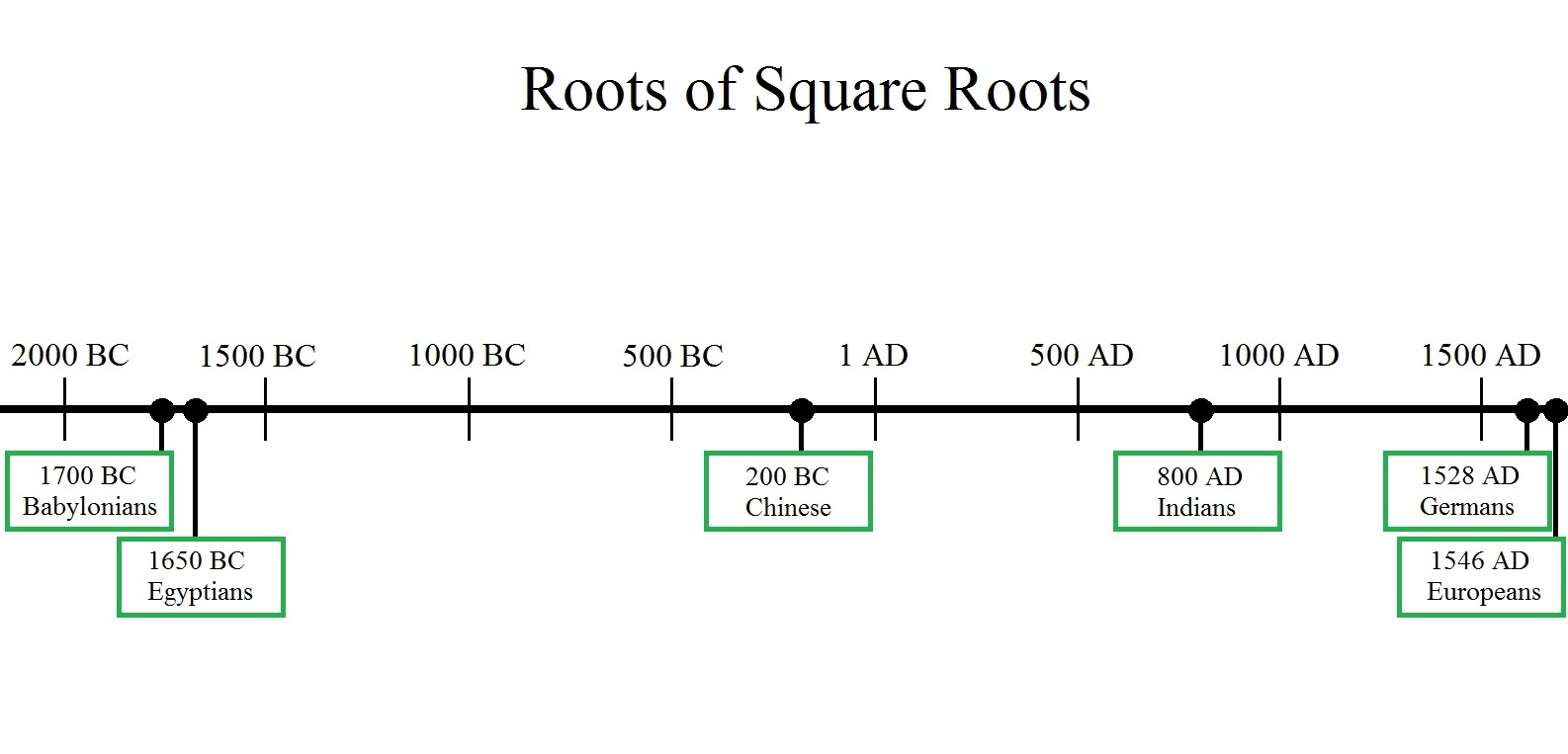
Many cultures have contributed to the concept of square roots. From 1800 BC to 1600 BC, the Babylonians created a clay tablet proving 2^1/2 and 30*2^1/2 using a square crossed by two diagonals. Within that time (1650 BC), a copy of an earlier work showed how the Egyptians extracted square roots. From 202 BC to 186 BC, the Chinese text Writings on Reckoning described a means to approximate the square roots of two and three. In the 9th century, the Indian mathematician Mahāvīra stated that square roots of negative numbers do not exist. Then, in 1546, Cantaneo introduced the idea of square roots to Europeans. The last major contribution to the concept of square roots was in 1528 when the German mathematician, Christoph Rudolff, introduced the modern root symbol in print for the first time.
To present this to the students, I would use the following timeline and proceed to briefly mention what each culture contributed to the topic of square roots.

E1. How can technology (YouTube, Khan Academy [khanacademy.org], Vi Hart, Geometers Sketchpad, graphing calculators, etc.) be used to effectively engage students with this topic?
The video, https://www.youtube.com/watch?v=AfBQGLowyKU, uses Elvis’s (You’re So Square) Baby I Don’t Care and recreates it with lyrics relating to square roots. This video not only accurately describes the main components of square roots, but also includes actual examples of perfect squares and square roots. It points out that the square root is the inverse of the square of a number. It also describes the base and the exponent which are directly related to the square root. Because the video is based off an actual song, it should effectively engage students and help them remember it since it’s catchy. Also, it is a great way to introduce the topic to the students where they want to know more, but aren’t overwhelmed with the amount of new information.
References:
Banta, Willy, prod. Think I’m a Square, Baby I Don’t Care. Perf. Elvis Presley. YouTube, 2011. Web. <http://www.youtube.com/watch?v=AfBQGLowyKU>.
Reulbach, Julie. “Square Roots with Cheez-Its and a Graphic Organizer.” I Speak Math., 3 May 2012. Web. <http://ispeakmath.org/2012/05/03/square-roots-with-cheez-its-and-a-graphic-organizer/>.
“Square Root.” Wikipedia. Wikipedia Foundation Inc., 10 Jan. 2014. Web. <http://en.wikipedia.org/wiki/Square_root#History>.
For your enjoyment:
Am I Going to Die This Year?
Here’s an unexpected application of exponential growth that I only learned about recently: the Gompertz Law of Human Mortality. It dictates that “your probability of dying in a given year doubles every eight years.”
Here’s the article that I read from NPR: http://www.npr.org/blogs/krulwich/2014/01/08/260463710/am-i-going-to-die-this-year-a-mathematical-puzzle?sc=tw&cc=share.
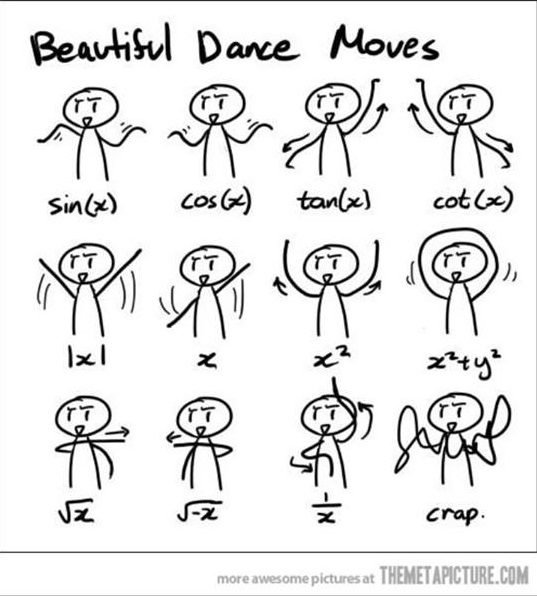
Beautiful Dance Moves
Collaborative Mathematics: Challenge 08
My colleague Jason Ermer at Collaborative Mathematics has just published Challenge 08 on his website:
A Political Redistricting Tool for the Rest of Us
I recently read an article that gives a taste of some of the mathematics and data analysis that (in part) determines how legislative districts are drawn to (hypothetically) prevent gerrymandering. I recommend it highly.
http://www.maa.org/publications/periodicals/a-political-redistricting-tool-for-the-rest-of-us
Trivia question for the day
Which is worth more: a pound of dimes, a pound of quarters, or a pound of dollars?
Rather than spoiling the fun for my readers, I’ll just leave this one unanswered and let you think about it. Feel free to Google for help.

An analysis of subtraction algorithms from the 18th and 19th centuries
Today I happily link to this wonderful article about how elementary school students “should” subtract two numbers, as it challenges the commonly held notion that there is only one way that subtraction should be implemented.
The common algorithm taught in schools today is the Decomposition Algorithm.
http://www.youtube.com/watch?v=3itmfsP6HoM
But there’s also the Equal Additions Algorithm.
http://www.youtube.com/watch?v=AN8XN_MSucI
And the Complement Algorithm.
http://www.youtube.com/watch?v=krNVuaIwi-o
And the Austrian Algorithm.
The author concludes:
The teaching and learning of subtraction is just as important today as it was in the past. Innovations in technology and mathematics curriculum have certainly occurred since the 1700s and 1800s, but the need for the teaching and learning of subtraction has not changed. Today, in many classrooms, subtraction is often taught through student-invented algorithms. Looking to the past may give teachers insight into invented algorithms or other algorithms students may use. Additionally, many teachers who do not encourage students to invent strategies teach only the “standard subtraction algorithm” presented in nearly every textbook across the United States, the decomposition algorithm. This research and analysis provides the modern teacher with an opportunity to reflect on the algorithms being taught in his or her classroom and allows the teacher to begin to think about why decomposition became the dominant algorithm in the United States. Teachers can ask their students to reflect on whether they agree with this historical turn of events. Incorporating the history of subtraction algorithms into modern elementary school mathematics invites robust mathematical discussion of subtraction and also of how, for many mathematical operations, there isn’t just one algorithm, but rather many algorithms from which to choose.
Exploring the history of subtraction in past school mathematics may provide us with insight into students’ mathematical struggles as they attempt to conceptualize not only subtraction, but also negative numbers and other notoriously challenging mathematical concepts. As educators and researchers, we need to devote more attention to issues in mathematics education such as the development of specific algorithms in elementary mathematics.
 Mean Green Math