I just read “But My Physics Teacher Said… A Mathematical Approach to a Physical Problem,” which was a very interesting pedagogical article concerning the teaching of calculus. Here’s the central problem:
I included on their exam a question involving average velocity. I gave the students a quadratic function and asked them to calculate the average velocity over a given interval… One of my students… got the final numerical answer correct, but he hadn’t used the average velocity formula he had learned in our course. Instead… he had calculated the average of the velocities at the end points of the given interval. When I explained this to him, he stated that he didn’t understand the difference because he had learned the latter formula to calculate average velocity in his physics class.
It turns out that this alternative approach always work under the condition of constant acceleration (i.e., a quadratic function), and since constant acceleration is such an important special case in freshman physics, the formula was presented and the student remembered the formula. Of course, the student probably was not aware of the formula was only generally true under this specific circumstance.
After some pedagogical reflection, the author concluded
My student and I both learned from this experience. He gave me the opportunity to look at a familiar topic with the eye of a physicist, and I taught him the importance of context when using a formula. Specific adventures such as the one my student and I encountered will undoubtedly strengthen my approach to teaching this course and my students’ ability to think like mathematicians.
This is one of most creative diagrams that I’ve ever seen: the depth of various solar system gravity wells. A large version of this image can be accessed at http://xkcd.com/681_large/.
From the fine print:
Each well is scaled so that rising out of a physical well of that depth — in constant Earth surface gravity — would take the same energy as escaping from that planet’s gravity in reality.
Depth =
It takes the same amount of energy to launch something on an escape trajectory away from Earth as it would to launch is 6,000 km upward under a constant Earth gravity. Hence, Earth’s well is 6,000 km deep.
Here’s some more details about the above formula.
Step 1. The escape velocity from the surface of a spherical planet is
,
where is the universal gravitational constant, is the mass of the planet, and is the radius of the planet. Therefore, the kinetic energy needed for a rocket with mass to achieve this velocity is
Step 2. Suppose that a rocket moves at constant velocity upward near the surface of the earth. Then the force exerted by the rocket exactly cancel the force of gravity, so that
,
where is the acceleration due to gravity near Earth’s surface. Also, work equals force times distance. Therefore, if the rocket travels a distance against this (hypothetically) constant gravity, then
The depth formula used in the comic is then found by equating these two expressions and solving for .
A personal pet peeve of mine are grade-school homework problems that are extremely poorly worded, thus leading to unnecessary confusion and bewilderment in students who (sadly) are already confused and bewildered more often than they (or we) would like. Here are two examples that I’ve seen recently.
(1) A worksheet gives the numbers 144 and 300 with the instructions “Find all of the ways to multiply to make each product. First, find the ways with two factors, and then find ways to multiply with more than two factors.”
The second half of the instructions can easily be interpreted by a child to mean “Find all of the ways to write 144 and 300 as a product with more than two factors.” This reading of the question (probably not intended by the author) will take even a gifted child a really, really long time to complete. Furthermore, I’m a professional mathematician, and even I have no idea off the top of my head if there’s an easy formula for the number of ways that a number can be expressed with an arbitrary number of factors greater than 1.
(2) A rocket blasts off. At 10.0 seconds after blast off, it is at 10,000 feet, traveling at 3600 mph. Assuming the direction is up, calculate the acceleration.
I assume that the author was trying to be cute by adding the “it is at 10,000 feet” part of the problem. Or the author wants the student to develop skill at weeding out unnecessary information (like the height) and identifying just the important information (the final velocity and the time) to calculate the quantity of interest.
But it’s aggravating that the information in the problem is not consistent, so there is no solution. In other words, it’s impossible for a rocket to travel with constant acceleration at travel 10000 feet at 3600 mph 10 seconds later.
To begin,
.
Therefore, the (presumably constant) acceleration is
.
However, using calculus, we can compute the height of the rocket by integrating twice:
Therefore, the height of the rocket after 10 seconds is , not the feet given in the problem.
In my capstone class for future secondary math teachers, I ask my students to come up with ideas for engaging their students with different topics in the secondary mathematics curriculum. In other words, the point of the assignment was not to devise a full-blown lesson plan on this topic. Instead, I asked my students to think about three different ways of getting their students interested in the topic in the first place.
I plan to share some of the best of these ideas on this blog (after asking my students’ permission, of course).
This student submission again comes from my student Allison Metzler. Her topic, from Pre-Algebra: square roots.
A2. How could you as a teacher create an activity or project that involves your topic?
The following activity, http://ispeakmath.org/2012/05/03/square-roots-with-cheez-its-and-a-graphic-organizer/, effectively engages students because it’s hands-on and allows the students to work together. The students would start with their own cheez-its, creating the smaller squares (1, 4,9). Then, they would work in groups by combining their cheez-its to make bigger squares. Eventually, they would come together as a class to see how big of a square they could create. This involves square roots because each time the student would create a square (assuming they know the properties of a square), they would see that the square root would equal the base of the square. Also, they would see that the base of a square could be any of its four sides because they are all congruent or equal. Thus, the reasoning behind the name, “square root”, would become more apparent. Because they wouldn’t have a calculator as a resource, this visual method of teaching would give the students a more efficient way of calculating square roots. This activity is an effective way to get the students to remember the concept of square roots because it involves food, it’s hands-on, and they’ll learn a visual method of calculating square roots.
D4. What are the contributions of various cultures to this topic?
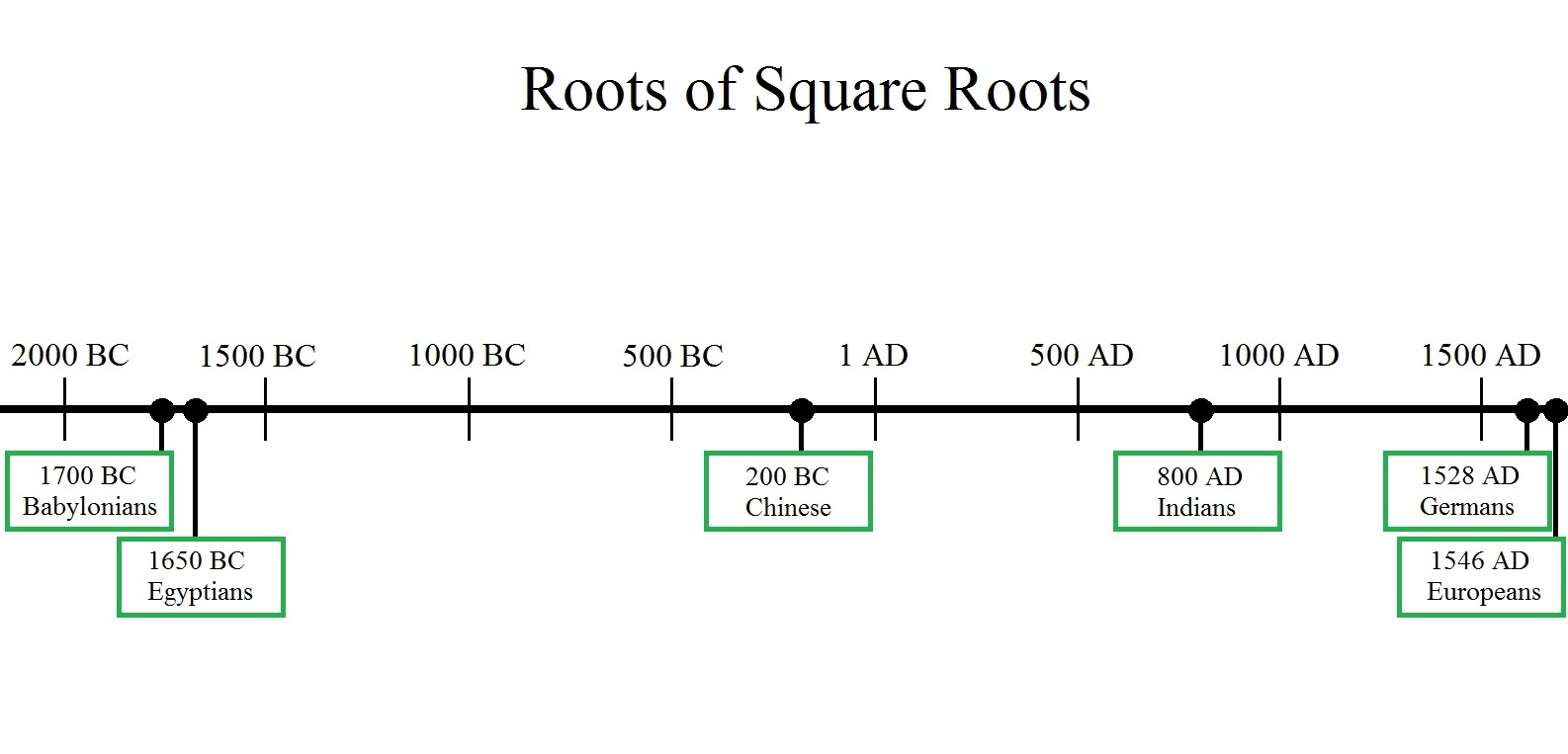
Many cultures have contributed to the concept of square roots. From 1800 BC to 1600 BC, the Babylonians created a clay tablet proving 2^1/2 and 30*2^1/2 using a square crossed by two diagonals. Within that time (1650 BC), a copy of an earlier work showed how the Egyptians extracted square roots. From 202 BC to 186 BC, the Chinese text Writings on Reckoning described a means to approximate the square roots of two and three. In the 9th century, the Indian mathematician Mahāvīra stated that square roots of negative numbers do not exist. Then, in 1546, Cantaneo introduced the idea of square roots to Europeans. The last major contribution to the concept of square roots was in 1528 when the German mathematician, Christoph Rudolff, introduced the modern root symbol in print for the first time.
To present this to the students, I would use the following timeline and proceed to briefly mention what each culture contributed to the topic of square roots.
E1. How can technology (YouTube, Khan Academy [khanacademy.org], Vi Hart, Geometers Sketchpad, graphing calculators, etc.) be used to effectively engage students with this topic?
The video, https://www.youtube.com/watch?v=AfBQGLowyKU, uses Elvis’s (You’re So Square) Baby I Don’t Care and recreates it with lyrics relating to square roots. This video not only accurately describes the main components of square roots, but also includes actual examples of perfect squares and square roots. It points out that the square root is the inverse of the square of a number. It also describes the base and the exponent which are directly related to the square root. Because the video is based off an actual song, it should effectively engage students and help them remember it since it’s catchy. Also, it is a great way to introduce the topic to the students where they want to know more, but aren’t overwhelmed with the amount of new information.
Here’s an unexpected application of exponential growth that I only learned about recently: the Gompertz Law of Human Mortality. It dictates that “your probability of dying in a given year doubles every eight years.”
Here’s the article that I read from NPR: http://www.npr.org/blogs/krulwich/2014/01/08/260463710/am-i-going-to-die-this-year-a-mathematical-puzzle?sc=tw&cc=share.


 Earth gravity. Hence, Earth’s well is 6,000 km deep.
 ,
, is the universal gravitational constant,
  is the mass of the planet, and
  is the radius of the planet. Therefore, the kinetic energy needed for a rocket with mass
  to achieve this velocity is
 ,
, is the acceleration due to gravity near Earth’s surface. Also, work equals force times distance. Therefore, if the rocket travels a distance
  against this (hypothetically) constant gravity, then
 .
. .
.

 , not the
  feet given in the problem.

 Mean Green Math