
We now turn to a little-taught and perhaps controversial inverse function: arcsecant. As we’ve seen throughout this series, the domain of this inverse function must be chosen so that the graph of 
The standard definition of 
![[0,\pi]](https://s0.wp.com/latex.php?latex=%5B0%2C%5Cpi%5D&bg=ffffff&fg=000000&s=0&c=20201002)

Why would this be controversial? Let’s fast-forward a couple of semesters and use implicit differentiation (see also https://meangreenmath.com/2014/08/08/different-definitions-of-logarithm-part-8/ for how this same logic is used for other inverse functions) to find the derivative of

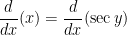
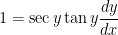

At this point, the object is to convert the left-hand side to something involving only 





So which is it, the positive answer or the negative answer? The answer is, without additional information, we don’t know!
- If
(so that
), then
.
- If
(so that
), then
.
We therefore have two formulas for the derivative of


These may then be combined into the single formula

 It gets better. Let’s now find the integral


Several calculus textbooks that I’ve seen will lazily give the answer

This answer works as long as 

![[2\sqrt{3}/3,2]](https://s0.wp.com/latex.php?latex=%5B2%5Csqrt%7B3%7D%2F3%2C2%5D&bg=ffffff&fg=000000&s=0&c=20201002)


However, the orange signed area on the interval ![[-2,-2\sqrt{3}/3]](https://s0.wp.com/latex.php?latex=%5B-2%2C-2%5Csqrt%7B3%7D%2F3%5D&bg=ffffff&fg=000000&s=0&c=20201002)



This is patently false, as the picture clearly indicates that the above integral has to be negative. For this reason, careful calculus textbooks will often ask students to solve a problem like

and the caveat
 Mean Green Math