Two ways of doing an integral (Part 2)

A colleague placed the following problem on an exam, expecting the following solution:

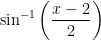
\displaystyle \int \frac{dx}{\sqrt{4x-x^2}} = \sin^{-1} \left( \displaystyle \frac{x-2}{2} \right) + C

However, one student produced the following solution (see yesterday’s post for details):

\displaystyle \int \frac{dx}{\sqrt{4x-x^2}} = 2 \sin^{-1} \left( \displaystyle \frac{\sqrt{x}}{2} \right) + C

As he couldn’t find a mistake in the student’s work, he assumed that the two expressions were equivalent. Indeed, he differentiated the student’s work to make sure it was right. But he couldn’t immediately see, using elementary reasoning, why they were equivalent. So he walked across the hall to my office to ask me if I could help.

Here’s how I showed they are equivalent.

Let \alpha = \displaystyle \sin^{-1} \left( \frac{x-2}{2} \right) and \beta = \sin^{-1} \left( \displaystyle \frac{\sqrt{x}}{2} \right) . Then

\displaystyle \sin(\alpha - 2\beta) = \sin \alpha \cos 2\beta - \cos \alpha \sin 2\beta.

Let’s evaluate the four expressions on the right-hand side.

First, \sin \alpha is clearly equal to \displaystyle \frac{x-2}{2}.

Second, \cos 2\beta = 1 - 2 \sin^2 \beta, so that

\cos 2\beta = \displaystyle 1 - 2\left( \frac{\sqrt{x}}{2} \right)^2 = \displaystyle 1 - \frac{x}{2} = \displaystyle -\frac{x-2}{2}.

Third, to evaluate $\cos \alpha$, I’ll use the identity \displaystyle \cos \left( \sin^{-1} x \right) = \sqrt{1 - x^2}:

\cos \alpha = \displaystyle \sqrt{1 - \left( \frac{x-2}{2} \right)^2 } = \displaystyle \frac{\sqrt{4x-x^2}}{2}

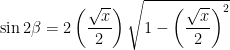
Fourth, \sin 2\beta = 2 \sin \beta \cos \beta. Using the above identity again, we find

\sin 2\beta = \displaystyle 2 \left( \frac{ \sqrt{x} }{2} \right) \sqrt{ 1 - \left( \frac{ \sqrt{x} }{2} \right)^2 }

= \sqrt{x} \sqrt{1 - \displaystyle \frac{x}{4}}

= \displaystyle \frac{\sqrt{4x-x^2}}{2}

 Combining the above, we find

\sin(\alpha - 2 \beta) = \displaystyle -\left( \frac{x-2}{2} \right)^2 - \left( \frac{\sqrt{4x-x^2}}{2} \right)^2

\sin(\alpha - 2 \beta) = \displaystyle \frac{-(x^2 - 4x + 4) - (4x - x^2)}{4}

\sin(\alpha - 2 \beta) = -1

\alpha - 2 \beta = \displaystyle -\frac{\pi}{2} + 2\pi n for some integer n

Also, since -\pi/2 \le \alpha \le \pi/2 and 0 \le -2\beta \le \pi, we see that -\pi/2 \le \alpha - 2 \beta \le 3\pi/2. (From its definition, $\beta$ is the arcsine of a positive number and therefore must be nonnegative.) Therefore, \alpha - 2\beta = -\pi/2.

In other words,

\sin^{-1} \left( \displaystyle \frac{x-2}{2} \right) and 2 \sin^{-1} \left( \displaystyle \frac{\sqrt{x}}{2} \right)

differ by a constant, thus showing that the two antiderivatives are equivalent.


Two ways of doing an integral (Part 1)

A colleague placed the following problem on an exam:

\displaystyle \int \frac{dx}{\sqrt{4x-x^2}}

He expected students to solve this problem by the standard technique, completing the square:

\displaystyle \int \frac{dx}{\sqrt{4x-x^2}} = \displaystyle \int \frac{dx}{4-(x-2)^2} = \sin^{-1} \left( \displaystyle \frac{x-2}{2} \right) + C

However, one student solved this problem by some clever algebra and the substitution u = \sqrt{x}, so that x = u^2 and dx = 2u \, du = 2 \sqrt{x} \, du:

\displaystyle \int \frac{dx}{\sqrt{4x-x^2}} = \displaystyle \int \frac{dx}{\sqrt{x} \sqrt{4-x}}

= \displaystyle \int \frac{dx}{\sqrt{x} \sqrt{4 - (\sqrt{x})^2}}

= \displaystyle \int \frac{2 \, du}{\sqrt{4 - u^2}}

= 2 \sin^{-1} \left( \displaystyle \frac{u}{2} \right) + C

= 2 \sin^{-1} \left( \displaystyle \frac{\sqrt{x}}{2} \right) + C

As he couldn’t find a mistake in the student’s work, he assumed that the two expressions were equivalent. Indeed, he differentiated the student’s work to make sure it was right. But he couldn’t immediately see, using elementary reasoning, why they were equivalent. So he walked across the hall to my office to ask me if I could help.

After a few minutes, I was able to show that the two expressions were equivalent.

I’ll leave this one as a cliff-hanger for now. In tomorrow’s post, I’ll show why they’re equivalent.

Engaging students: The quadratic formula

In my capstone class for future secondary math teachers, I ask my students to come up with ideas for engaging their students with different topics in the secondary mathematics curriculum. In other words, the point of the assignment was not to devise a full-blown lesson plan on this topic. Instead, I asked my students to think about three different ways of getting their students interested in the topic in the first place.

I plan to share some of the best of these ideas on this blog (after asking my students’ permission, of course).

This student submission again comes from my former student Daniel Littleton. His topic, from Algebra II: the quadratic formula.

green line

A1: What interesting word problems using this topic can your students do now?

The quadratic equation is a formula used to find the solutions of second order polynomials. Meaning, that if f(x) is a polynomial with the highest power of x being two the quadratic equation may be used to find the solution set of the function. This solution set describes the values at which the function crosses the x-axis, resulting in a solution set of (x_1, 0), (x_2, 0). These points on the graph of the function are often referred to as the zeroes of the function.

With this knowledge regarding the information that is derived from the quadratic equation, a student could be asked the following word problem.

“Congratulations, your motorcycle stunt career is really taking off. Now it is time for you to get ready for your next jump off of a ramp. Your team has determined that in the arena you will be performing in it will be safe for your jump to follow the path of the following function, f(x) = -10/87x^2 + 11/29x + 5, where x is measured in meters. They determined this from setting the middle of the arena to the origin of the graph, (0, 0); and from the knowledge that the total length of the arena is 24 meters. In order to ensure your safety, you need to inspect the set-up of the stunt and ensure everything was done correctly. At what points on the graph will you take off into your jump, and land from your jump? Also, how many meters of open arena will you have behind you at the beginning of your jump and in front of you after your landing?”

The solution set of this equation are the points at which the motorcycle rider would leave the ground for the jump, and fall back to the ground for the landing. It can be easily determined that factoring this quadratic equation is not a feasible option to find the solution set. Therefore, the student would use the quadratic formula with a=(-10/87), b=(11/29) and c=5. After using the quadratic formula the student will arrive at the solution set of (-5.15, 0) and (8.45, 0). The student would interpret this data to mean that the jump begins 5.15 meters back from the center of the arena and ends 8.45 meters ahead of the center of the arena. The rider would also have 6.85 meters of clearance behind him at the start of the jump, and 3.55 meters of clearance in front of him at the end of the jump. These solutions are determined from the knowledge that the total length of the arena is 24 meters and the center of the arena is the origin of the graph.

This is one stimulating example of a word problem that a student could complete in order to engage their interest in the quadratic formula. Word problems following this could vary in complexity and application.


green line

B1: How can this topic be used in your students’ future courses in mathematics or science?

The quadratic equation has multiple applications in solving polynomial equations of the second degree. In future mathematics courses, most likely at the Pre-Calculus level, students will be asked to solve for variables within trigonometric equations. These equations can also be solved using the quadratic equation when the options of using linear interpretations, factoring, or trigonometric identities is not feasible.

For example, a student could be asked to find all solutions of the formula cot x(cot x + 3) = 1. After factoring the equation and setting the answer equal to zero we derive a standard quadratic form of the equation, cot ^2 x + 3 cot x – 1 = 0. The quadratic equation can be utilized in this situation by setting a=1, b=3, c= (-1) and cot x as the variable. After using the quadratic formula we determine the solutions of cot x = (-3.302775638) or (.3027756377). As a calculator cannot be used to find the inverse of cotangent, we use the fact that cot x = 1/tan x and take the reciprocals of the solutions to find that tan x= (-.3027756377) or (3.302775638). By finding the inverse tangent of these values we conclude that x = (-.2940013018) or (1.276795025).

I would like to take this opportunity to note that this is only one set of the solutions to the value of x. In order to express all solutions we need to add integer multiples of the period of the tangent, π, to each of the expressed solutions. Resulting in the final solutions of

x = (-.2940013018) + nπ or (1.276795025) + nπ where n ϵ integers.

This is one example of an occasion when a student would need to apply the quadratic equation in order to derive a solution to an advanced trigonometric formula.

green line

D1: What interesting things can you say about the people who contributed to the discovery and/or development of this topic?

The first efforts to discover a general formula to solve quadratic equations can be traced back to the efforts of Pythagoras and Euclid. Pythagoras and his followers are the ones responsible for the development of the Pythagorean Theorem. Euclid was the individual responsible for the development of the subject of Geometry as it is still used today. The efforts of these two individuals took a strictly geometric approach to the problem; however Pythagoras first noted that the ratios between the area of a square and the length of the side were not always an integer. Euclid built upon the efforts of Pythagoras by concluding that this proportion might not be rational and irrational numbers exist. The works of Euclid and Pythagoras traveled from ancient Greece to India where Hindu mathematicians were using the decimal system that is still in use today. Around 700 A.D. the general solution for the quadratic equation, using the number system, was developed by the mathematician Brahmagupta. Brahmagupta used irrational numbers in his analysis of the quadratic equation and also recognized the existence of two roots in the solution.

By the year 820 A.D. the advancements made by Brahmagupta had traveled to Persia, where a mathematician by the name of Al-Khwarizmi completed further work on the derivation of the quadratic equation. Al-Khwarizmi is the Islamic mathematician given the greatest amount of credit for the development of Algebra as it is known today. However, Al-Khwarizmi rejected the possibility of negative solution. The works of Al-Khwarizmi were brought to Europe by Jewish mathematician Abraham bar Hiyya. It was in the Renaissance Era of Europe, around 1500 A.D., that the quadratic equation in use today was formulated. By 1545 A.D. Girolamo Cardano, a Renaissance scientist, compiled the works of Al-Khwarizmi and Euclid and completed work upon the quadratic equation allowing for the existence of complex numbers. After the development of a universally accepted system of symbols for mathematicians, this form of the quadratic formula was published and distributed throughout the mathematical and scientific community.

This information was collected from the web page http://www.bbc.co.uk/dna/place-london/plain/A2982567


Engaging students: Deriving the distance formula

In my capstone class for future secondary math teachers, I ask my students to come up with ideas for engaging their students with different topics in the secondary mathematics curriculum. In other words, the point of the assignment was not to devise a full-blown lesson plan on this topic. Instead, I asked my students to think about three different ways of getting their students interested in the topic in the first place.

I plan to share some of the best of these ideas on this blog (after asking my students’ permission, of course).

This student submission again comes from my former student Shama Surani. Her topic, from Geometry: deriving the distance formula.

green line

A1. What interesting word problems using this topic can your students do now?


By viewing examples on http://www.spacemath.nasa.gov, I came across the following word problem:


A beam of light, traveling at 300,000 km/sec is sent in a round trip between spacecraft located Earth (0,0), Mars (220, 59), Neptune (-3200, -3200), and back to Earth. If the coordinate units are in millions of kilometers, what are:


A)    The total round-trip distance (Earth, Mars, Neptune, Earth) in billions of kilometers?

B) The round trip time in hours?


I believe this problem is an interesting one to ask the students because I believe this question will pique the interests of the students especially if a video clip or visual is presented to grab their attention. This question allows me as a teacher to assess what the students know, and if they can apply the previous concepts learned to this new concept. By the end of the lesson, the students will be able to find out the total distance, and also apply previous concepts with distance = rate * time to figure out how many hours the round trip took.

By the end of the lesson, the students will be able to answer these questions. This problem builds on previous concepts taught so students can tie and see the connections among all topics.

Click to access 377674main_Black_Hole_Math.pdf


green line

A2. How could you as a teacher create an activity or project that involves you topic?

As a teacher, I can create an activity or project that involves the distance formula. I will provide a map of the United States, and have the students plan a trip across the USA covering at least 10 states, and making pit stops along the way of places they would want to visit, such as the Grand Canyon, Las Vegas, etc. The students will have to find the distance of the total trip, as well as the distance between each pit stop. This activity helps the students practice the distance formula while allowing the students to become familiar with the United States and interesting locations to visit in the United States. The students will know be able to see how the calculating distance is related to real life.

http://livelovelaughteach.wordpress.com/category/midpoint-formula/

green line

D1. What interesting things can you say about the people who contributed to the discovery and/or the development of this topic?

Pythagoras, Euclid, and Descartes are the three main mathematicians who are most responsible for the development of the distance formula.  Pythagoras is acknowledged by many scholars as being the one to have invented the distance formula although much record in history has been lost during this period. He was born around 570 B.C. in Samos. As a Greek mathematician and philosopher, he traveled to other parts of the world to learn from other civilizations, and he always was seeking the meaning of life. Pythagoras was amazed with distances as he travelled to Egypt, Babylon, Arabia, Judea, India, and Phoenicia. He is the one credited for one of the first proofs of the Pythagorean theorem, a2 + b2 = c2. The distance formula is derived from the Pythagorean theorem.

Euclid, known as the father of Geometry, also contributed to the distance formula. His third axiom states, “It is possible to construct a circle with any point as its center and with a radius of any length.” If one considers the equation of a circle, x2 + y2 = r2, one will notice that the distance formula is a rearrangement of the equation of a circle formula.

Renee Descartes was the one who developed the coordinate system that allows connection from algebra to geometry. He took the concepts of Euclid and Pythagoras in order to relate the radius to the center point of the circle. Essentially, Descartes came up with the equations used for circles and distance between two points that are used today.


http://harvardcapstone.weebly.com/history2.html


References:


http://www.cs.unm.edu/~joel/NonEuclid/proof.html


http://harvardcapstone.weebly.com/history2.html


http://livelovelaughteach.wordpress.com/category/midpoint-formula/


Engaging students: Classifying polygons

In my capstone class for future secondary math teachers, I ask my students to come up with ideas for engaging their students with different topics in the secondary mathematics curriculum. In other words, the point of the assignment was not to devise a full-blown lesson plan on this topic. Instead, I asked my students to think about three different ways of getting their students interested in the topic in the first place.

I plan to share some of the best of these ideas on this blog (after asking my students’ permission, of course).

This student submission again comes from my former student Samantha Smith. Her topic, from Geometry: classifying polygons.

green line

D. 4. What are the contributions of various cultures to this topic?

Tangrams

The tangram is a puzzle game that originated in China. It has been documented that this puzzle has been played since at least the early 1800s, and even before that. By around 1817, the tangram had gained popularity in Europe and America. Its components consist of seven pieces: one square, one parallelogram, two small isosceles triangles, one medium isosceles triangle, and two large isosceles triangles. Each piece is called a tan. The shapes can be arranged into different figures. As you can see in the picture below, these pieces can be arranged in many ways. For the classroom, the teacher can give the students tans to make their own figures, or the teacher can give them a silhouette of a figure and have the students create the tangram. This is just a fun way to have the students interact with the shapes they are learning about, and experience some world culture.

tangram

http://www.activityvillage.co.uk/tangram-black-and-white

http://www.logicville.com/tangram.htm


green line

B.2. How does this topic extend what your students should have learned in previous courses?

Geo-Boards

When I took Concepts of Algebra and Geometry last semester, we had a full lesson on polygons. The professor gave us a tool called a Geo-Board to model polygons using rubber bands (as pictured below). This was a really fun and short hands-on activity to engage us in the lesson. After we made our shape with the rubber band, we would go more in depth and triangulate it to find the sum of the angles in the polygon. The Geo-Board will be exciting for high school students. The teacher can name a familiar shape that the students can model on their board. Most of the shapes they will be modeling they will have worked with in many previous math courses. Another cool thing about the Geo-Board is that the students can see there is more than one way to make a polygon, as long as they have the right number of sides. Of course there are stricter rules for squares, equilateral triangles, etc.; however, students can still model those shapes on the Geo-Board while the teacher walks around and checks their work.

geoboard2

green line

C. How has this topic appeared in culture?


Traffic Signs


Every day people get into cars and drive. They are expected to follow the laws of the road. One of the first things you learn in Driver’s Ed. are the different traffic signs; their colors, their shapes and what they mean. What I notice is that traffic signs are in the shapes of polygons, and their shape is important to their meaning. A stop sign is an octagon, a yield sign is a triangle, and a pedestrian crossing sign is a pentagon. Knowing these shapes can help determine what a sign means, especially if the driver is too far away to read what it says.

traffic

This is an everyday use of classifying polygons. Students do it all the time; they just might not realize it. Engaging high school students with traffic signs could prove beneficial for them in more ways than one: not just learning about shapes, but about traffic signs they will be tested on before they get their driver’s license, which is what many students are doing in high school.


Engaging students: Finding the area of a circle

In my capstone class for future secondary math teachers, I ask my students to come up with ideas for engaging their students with different topics in the secondary mathematics curriculum. In other words, the point of the assignment was not to devise a full-blown lesson plan on this topic. Instead, I asked my students to think about three different ways of getting their students interested in the topic in the first place.

I plan to share some of the best of these ideas on this blog (after asking my students’ permission, of course).

This student submission again comes from my former student Rebekah Bennett. Her topic, from Geometry: finding the area of a circle.

green line

Culture:

The area of a circle is used in our everyday life. Landscaping uses this topic quite a bit. Suppose a person wants to put a circular pool or even a fountain in their yard. The landscaper needs to know the area of the basic circle that is being used so that they can make sure there is enough land to build on. We also know contractors use this everyday too. When building a circular building, the contractor needs to know the area of the base of the building so that he/she can clear a big enough area. They also use this when building circular columns, such as the ones you would see on a big, fancy building. The contractor must know how much area the base (circle) takes up to see how much of the platform they have left to work with. Then he/she can now see how many evenly spaced columns will fit on the platform. A room designer also comes to mind. Let’s say if someone wanted a circular table placed in their living room, the designer needs to know how much space (area) the table takes up in order to figure out how much area is left in the room to fit other items comfortably. These are all instances where someone in the artistic world would need to use area of a circle.


green line

Application and Technology:

To explore this topic, I would give each student a cut out of a circle, each circle having a different size. Then I would tell them to figure out the area of the circle. I would give them hints as to how would you use the radius, diameter, and circumference within a formula. I would suggest the idea of splitting the circle into even pieces, and then ask the students if there is a way that they can transform the pieces of a circle into a more familiar shape. The students would have about 5 minutes to experiment on their own and then I would show them this video.

This video shows the students a more in depth definition of area of a circle. The video actually derives the formula from the normal area formula of a parallelogram (base x height). Here we pull the whole circle apart, piece by piece to create a parallelogram. The video relates height to radius and base to ½ of the circumference. These are both previous terms that the student already knows. The guy in the video manipulates the area formula for a parallelogram to derive the area of a circle. This video is a great way to show students that there is more than one way of solving for the right answer but also more importantly, it shows where the formula for area of a circle actually comes from. This gives the student a justification as to how and why we created this formula, relating back to the exploration.

After watching the explanation from the video, the students would now have a chance to replicate the demonstration with their original circle. By having the students recreate the video demonstration themselves, it gives them a better understanding as to why the formula works like it does and they can see how the formula works with a guided hands on approach.


green line

Curriculum:

From previous math courses, the student should already know the terms of a circle such as; radius, diameter and circumference. The student should know how to find the radius given the diameter, vice versa. The student knows that the circumference is the perimeter of a circle and how to find it, given the radius or diameter. They should already know the term area: space that an object takes up. The student should know how to find the area of a rectangle and parallelogram: (length x width) or (base x height). This activity shows how to relate the area of a circle to the area of a rectangle, given the radius and height, which is the same thing. The student can now create a formula for the area of a circle by using the same method as solving for area of a rectangle or parallelogram. The area of a circle extends the previous knowledge that every student should learn in algebra before entering a geometry class.


Engaging students: Defining the acute, right, and obtuse

In my capstone class for future secondary math teachers, I ask my students to come up with ideas for engaging their students with different topics in the secondary mathematics curriculum. In other words, the point of the assignment was not to devise a full-blown lesson plan on this topic. Instead, I asked my students to think about three different ways of getting their students interested in the topic in the first place.

I plan to share some of the best of these ideas on this blog (after asking my students’ permission, of course).

This student submission again comes from my former student Randall Hall. His topic, from Geometry: defining the terms acute, right, and obtuse.

green line

D4. What are the contributions of various cultures to this topic?

In ancient times, Euclid adopted the idea of a right angle and defined a right angle to be an angle that was to be congruent to it, an acute angle was denoted by less than a right angle and obtuse angle was denoted to be greater than a right angle. Euclid defined it that way because back then Geometry wasn’t associated with numbers; Geometry was associated with circles, lines, line segments and triangles. Many things we know now such as the Pythagorean Theorem can be explained by what we know now to be a right angle.

The Babylonians were one of the first to use degrees in measurements of astronomy between 5000 and 4000 BC. The Babylonians had an interesting number system in that they used a base-60 counting system while today we use a base-10 system. It is because of them that we have a sixty minutes in an hour and 360 degrees in a circle.

Source: http://math.ucsd.edu/~wgarner/math4c/textbook/chapter5/angles_radians.htm


green line

D5. How have different cultures throughout time used this topic in their society?

The history of the mathematical measurement of angles possibly dates back to 1500BC in Egypt, where measurements were taken of the Sun’s shadow against graduations marked on stone tables, examples of which can be seen in the Egyptian Museum in Berlin. The shadow was cast but a vertical rod (Gnomon) along the length of the markings on a stone tablet, enabling time and seasons to be measured with some degree of accuracy.

The first known instrument for measuring angles was possibly the Egyptian Groma, an instrument used in construction massive objects such as the pyramids. The Groma consisted of four stones hanging by cords from sticks set at right angles; measurements were then taken by the visual alignment of two of the suspended cords and the point to be set out. It was limited due to it was only usable on fairly flat terrain and its accuracy limited by distance. The Groma continued to set out right angles for many Roman constructions, including roads, which were straight lines, set by the Groma.

Source: http://www.fig.net/pub/cairo/papers/wshs_01/wshs01_02_wallis.pdf


green line

E1. How can technology (YouTube, Khan Academy [khanacademy.org], Vi Hart, Geometers Sketchpad, graphing calculators, etc.) be used to effectively engage students with this topic?

The link below contains a great JAVA applet that features an angle within the apple that allows the user to designate what the user wants the angle to be. In addition to showing the angle, the applet will recognize that number and then output the appropriate angle type. For example, if the applet recognizes a 90 in the “degree of angle” box and then outputs ‘Right’. In addition to the JAVA application, a description of an angle is given for each type of angle. The classifications of angles are: acute, right, obtuse, straight, reflux, and full rotation. This is excellent for the student because it provides the student a visual of what each type of angles look like. Visuals, such as this, are good for the student because it encompasses all types of learning style. It is also good for ESL learners because it provides them an alternative method for interpreting what is being discussed.

http://www.cut-the-knot.org/Curriculum/Geometry/Angle.shtml

The Best Job of 2014: Mathematician

Sources: http://blogs.wsj.com/atwork/2014/04/15/best-jobs-of-2014-congratulations-mathematicians/ and http://www.careercast.com/jobs-rated/best-jobs-2014

Another day, another reason to get better at math.

It’s no secret that quantitative skills are in high demand on the job market—one analytics recruiter recently told The Journal that workers who can’t crunch numbers may ultimately face a “permanent pink slip.”

Now, a new ranking from the job-search website CareerCast.com names mathematician as the best occupation of 2014. “Math skills unlock a world of career opportunities,” publisher Tony Lee said. (Cue the Square One theme, and tune in Mathnet.)

Data whizzes of all stripes fared well in the annual list: Statisticians (No. 3), actuaries (No. 4) and computer systems analysts (No. 8) all landed near the top.

On a related note, I’m often asked what careers are possible in mathematics. A great resource is provided by the American Mathematical Society at http://www.ams.org/profession/career-info/career-index.