Two ways of doing an integral (Part 2)

A colleague placed the following problem on an exam, expecting the following solution:

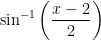
\displaystyle \int \frac{dx}{\sqrt{4x-x^2}} = \sin^{-1} \left( \displaystyle \frac{x-2}{2} \right) + C

However, one student produced the following solution (see yesterday’s post for details):

\displaystyle \int \frac{dx}{\sqrt{4x-x^2}} = 2 \sin^{-1} \left( \displaystyle \frac{\sqrt{x}}{2} \right) + C

As he couldn’t find a mistake in the student’s work, he assumed that the two expressions were equivalent. Indeed, he differentiated the student’s work to make sure it was right. But he couldn’t immediately see, using elementary reasoning, why they were equivalent. So he walked across the hall to my office to ask me if I could help.

Here’s how I showed they are equivalent.

Let \alpha = \displaystyle \sin^{-1} \left( \frac{x-2}{2} \right) and \beta = \sin^{-1} \left( \displaystyle \frac{\sqrt{x}}{2} \right) . Then

\displaystyle \sin(\alpha - 2\beta) = \sin \alpha \cos 2\beta - \cos \alpha \sin 2\beta.

Let’s evaluate the four expressions on the right-hand side.

First, \sin \alpha is clearly equal to \displaystyle \frac{x-2}{2}.

Second, \cos 2\beta = 1 - 2 \sin^2 \beta, so that

\cos 2\beta = \displaystyle 1 - 2\left( \frac{\sqrt{x}}{2} \right)^2 = \displaystyle 1 - \frac{x}{2} = \displaystyle -\frac{x-2}{2}.

Third, to evaluate $\cos \alpha$, I’ll use the identity \displaystyle \cos \left( \sin^{-1} x \right) = \sqrt{1 - x^2}:

\cos \alpha = \displaystyle \sqrt{1 - \left( \frac{x-2}{2} \right)^2 } = \displaystyle \frac{\sqrt{4x-x^2}}{2}

Fourth, \sin 2\beta = 2 \sin \beta \cos \beta. Using the above identity again, we find

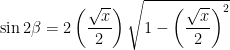
\sin 2\beta = \displaystyle 2 \left( \frac{ \sqrt{x} }{2} \right) \sqrt{ 1 - \left( \frac{ \sqrt{x} }{2} \right)^2 }

= \sqrt{x} \sqrt{1 - \displaystyle \frac{x}{4}}

= \displaystyle \frac{\sqrt{4x-x^2}}{2}

 Combining the above, we find

\sin(\alpha - 2 \beta) = \displaystyle -\left( \frac{x-2}{2} \right)^2 - \left( \frac{\sqrt{4x-x^2}}{2} \right)^2

\sin(\alpha - 2 \beta) = \displaystyle \frac{-(x^2 - 4x + 4) - (4x - x^2)}{4}

\sin(\alpha - 2 \beta) = -1

\alpha - 2 \beta = \displaystyle -\frac{\pi}{2} + 2\pi n for some integer n

Also, since -\pi/2 \le \alpha \le \pi/2 and 0 \le -2\beta \le \pi, we see that -\pi/2 \le \alpha - 2 \beta \le 3\pi/2. (From its definition, $\beta$ is the arcsine of a positive number and therefore must be nonnegative.) Therefore, \alpha - 2\beta = -\pi/2.

In other words,

\sin^{-1} \left( \displaystyle \frac{x-2}{2} \right) and 2 \sin^{-1} \left( \displaystyle \frac{\sqrt{x}}{2} \right)

differ by a constant, thus showing that the two antiderivatives are equivalent.


One thought on “Two ways of doing an integral (Part 2)

Leave a comment

This site uses Akismet to reduce spam. Learn how your comment data is processed.