Approximating pi

I was recently interviewed by my city’s local newspaper about \pi Day and the general fascination with memorizing the digits of \pi. I was asked by the reporter if the only constraint in our knowledge of the digits of \pi was the ability of computers to calculate the digits, and I answered in the affirmative.

Here’s the current state-of-the-art for calculating the digits of \pi. Amazingly, this expression was discovered  1995… in other words, very recently.

\pi = \displaystyle \sum_{n=0}^\infty \frac{1}{16^n} \left( \frac{4}{8n+1} - \frac{2}{8n+4} - \frac{1}{8n+5} - \frac{1}{8n+6} \right)

Because of the term 16^n in the denominator, this infinite series converges very quickly.

Proof: If k < 8, then we calculate the integral I_k, defined below:

I_k = \displaystyle \int_0^{1/\sqrt{2}} \frac{x^{k-1}}{1-x^8} dx

= \displaystyle \int_0^{1/\sqrt{2}} x^{k-1} \sum_{n=0}^\infty x^{8n} dx

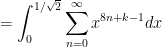
= \displaystyle \int_0^{1/\sqrt{2}} \sum_{n=0}^\infty x^{8n+k-1} dx

= \displaystyle \sum_{n=0}^\infty \int_0^{1/\sqrt{2}} x^{8n+k-1} dx

= \displaystyle \sum_{n=0}^\infty \left[ \frac{x^{8n+k}}{8n+k} \right]^{1/\sqrt{2}}_0

= \displaystyle \sum_{n=0}^\infty \frac{1}{8n+k} \left[ \left( \frac{1}{\sqrt{2}} \right)^{8n+k} - 0 \right]

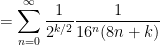
= \displaystyle \sum_{n=0}^\infty \frac{1}{2^{k/2}} \frac{1}{16^n (8n+k)}

We now form the linear combination P = 4\sqrt{2} I_1 - 8 I_4 - 4\sqrt{2} I_5 - 8 I_6:

P = \displaystyle \sum_{n=0}^\infty \left( \frac{4\sqrt{2}}{2^{1/2}} \frac{1}{16^n (8n+1)} - \frac{8}{2^{4/2}} \frac{1}{16^n (8n+4)} - \frac{4\sqrt{2}}{2^{5/2}} \frac{1}{16^n (8n+5)} - \frac{8}{2^{6/2}} \frac{1}{16^n (8n+6)} \right)

P = \displaystyle \sum_{n=0}^\infty \frac{1}{16^n} \left( \frac{4}{8n+1} - \frac{2}{8n+4} - \frac{1}{8n+5} - \frac{1}{8n+6} \right)

Also, from the original definition of the I_k,

P = \displaystyle \int_0^{1/\sqrt{2}} \frac{4\sqrt{2} - 8x^3 -4\sqrt{2} x^4 - 8x^5}{1-x^8} dx.

Employ the substitution x = y/\sqrt{2}:

P = \displaystyle \int_ 0^1 \frac{4\sqrt {2} - 2\sqrt {2} y^3 - \sqrt {2} y^4 - \sqrt {2} y^5}{1 - y^8/16}\frac {dy} {\sqrt {2}}

P = \displaystyle \int_ 0^1 \frac{16 (4 - 2 y^3 - y^4 - y^5)}{16 - y^8} dy

P = \displaystyle \int_0^1 \frac{16(y-1)(y^2+2)(y^2+2y+2)}{(y^2-2)(y^2+2)(y^2+2y+2)(y^2-2y+2)} dy

P = \displaystyle \int_0^1 \frac{16y-16}{(y^2-2)(y^2-2y+2)} dy

Using partial fractions, we find

P = \displaystyle \int_ 0^1\frac{4 y}{y^2 - 2} dy - \int_ 0^1 \frac{4 y - 8}{y^2 - 2 y + 2} dy

The expression on the right-hand side can be simplified using standard techniques from Calculus II and is equal to \pi.

green line

So that’s the proof… totally accessible to a student who has mastered concepts in Calculus II. But this begs the question: how in the world did anyone come up with the idea of starting with the integrals $I_k$ to develop an infinite series that leads to \pi? Let me quote from page 118 of J. Arndt and C. Haenel, \pi - Unleashed (Springer, New York, 2000):

Certainly not by chance, even if luck played some part in the discovery. All three parties [David Bailey, Peter Borwein and Simon Plouffe] are established mathematicians who have been working with the number \pi for a considerable time… Yet the series was not discovered through mathematical deduction or inference. Instead, the researchers used a tool called Computer Algebra System and a particular procedure called the “PSQL algorithm” to generate their series. They themselves write that they found their formula “through a combination of inspired testing and extensive searching.”

The original paper that announced the discovery of this series can be found at http://www.cecm.sfu.ca/personal/pborwein/PAPERS/P123.pdf.

Leave a comment

This site uses Akismet to reduce spam. Learn how your comment data is processed.