
Every once in a while, I’ll give a “fun lecture” to my students. The rules of a “fun lecture” are that I talk about some advanced applications of classroom topics, but I won’t hold them responsible for these ideas on homework and on exams. In other words, they can just enjoy the lecture without being responsible for its content.
In this series of posts, I’m describing a fun lecture on generating functions that I’ve given to my Precalculus students. In the previous post, we looked at the famed Fibonacci sequence

We also looked at that (slightly less famous) Quintanilla sequence

which is defined so that each term is the sum of the previous term and twice the term that’s two back in the sequence. We also used the Bag of Tricks to find that the generating function is
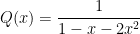
 To get a closed-form definition of the Quintanilla sequence, let’s find the partial-fraction decomposition of

To find the partial fraction decomposition, we need to find the constants 


or

Perhaps the easiest way of finding 
- If
, then we obtain
, or
.
- If
, then we obtain
, or
.
Therefore,

Finally, let’s write the rational functions on the right-hand side as infinite series. Using the formula for an infinite geometric series, we find

Notice that this matches the terms of the Quintanilla sequence! For example, the coefficient of the 

which is a term of the Quintanilla sequence.
In general, the coefficient of the 

This is the long-awaited closed-form expression for the Quintanilla sequence. For example, we quickly see that the 12th term is 
 Mean Green Math
One thought on “Fun lecture on geometric series (Part 4): The Fibonacci sequence”