
In my capstone class for future secondary math teachers, I ask my students to come up with ideas for engaging their students with different topics in the secondary mathematics curriculum. In other words, the point of the assignment was not to devise a full-blown lesson plan on this topic. Instead, I asked my students to think about three different ways of getting their students interested in the topic in the first place.
I plan to share some of the best of these ideas on this blog (after asking my students’ permission, of course).
This student submission comes from my former student Michelle McKay. Her topic, from Algebra II: deriving the distance formula.

C. How has this topic appeared in pop culture?
Numb3rs is a relatively popular TV show that revolves around the character Dr. Charlie Eppes, a mathematician. The show’s plot is primarily centralized around Dr. Eppes’ ability to help the FBI solve various crimes by applying mathematics.
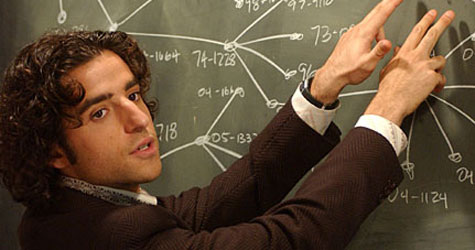
In the pilot episode, Dr. Eppes uses Rossmo’s Formula to help narrow down the current residence of a criminal to a neighborhood. Rossmo’s Formula is a very interesting in that it predicts the probability that a criminal might live in various areas. In the Numb3rs episode, Charlie manipulates the formula and projects the results onto a map to show the hot spot, or rather, the location where the criminal is most likely to be living in.
Rossmo’s Formula, however, would not be complete without including what we know as a Manhattan distance formula, which is just a derivation of the Euclidian distance formula.
From the distance formula we can derive…
The distance formula is a byproduct of Pythagorean’s Theorem. By examining any two points on a two dimensional plane, x and y components could be observed and used to calculate the distance between the points by forming a right triangle and solving for the hypotenuse. Later in time, the distance formula has been adapted to fit many different situations. To name a few, there is distance in Euclidean space and its variations (Euclidean distance, Manhattan or taxicab distance, Chebyshev distance, etc.), distance between objects in more than two dimensions, and distances between a point and a set.
E. Technology
The best way for students to really understand the distance formula is to allow them to make it their discovery. We can handle this in many ways. One of the more obvious explorations is to give them a piece of graph paper and have them plot points. However, this is an instance where technology can serve a great purpose in the classroom. There are vast amounts of apps online that will allow students to manipulate two points on a grid. After looking at several different apps, I find the one I have listed in the sources to be great for a few reasons. First, students can move two points around a virtual grid. This is a “green” activity and saves paper. Second, while students move the points, a right triangle is automatically drawn for them. Depending on the level of the class, students can make connections between the Pythagorean Theorem and how it leads to the distance formula. Third, above the grid is an interactive equation. It automatically plugs in the values of the points on the grid and finds the distance between them. What is even more impressive is that it solves the equation in steps.
 Mean Green Math
I am trying to find the app you mention in your article [Engaging Students: Deriving the distance formula], stated to be listed in sources, yet I am unable to locate the “sources”. Would you be so kind as to name the app or provide a link to it. Thank you.
Thank you for inquiring, and I’m sorry for the inconvenience… that was my fault in copying her work over to my blog. Here are the sources that Ms. McKay listed.
Sources:
1. http://fairytail.wikia.com/wiki/File:Numb3rs_guy.jpg
2. http://taxicabgeometry.net/index.html
3. http://mathworld.wolfram.com/ChebyshevsTheorem.html
4. http://mathworld.wolfram.com/Point-LineDistance3-Dimensional.html
5. http://digginomics.blogspot.com/2010/02/rossmo-s-formula-find-serial-killers.html
6. http://www.mathwarehouse.com/algebra/distance_formula/interactive-distance-formula.php